
Trainings & Workshops
Current stand-alone trainings & workshops
Listening Labs: Tools & Artistry for Connection
Even after the 2024 elections, and amidst intensifying fragmentation, some 70% of Americans — across party lines — feel they have a sense of responsibility to connect with people whose ethnic, political, religious and economic backgrounds and viewpoints are different from their own(1). The most common reason people give for seeking such “bridging” is to improve their communities. Among the most reliable reasons people do not do this is anxiety about engaging with others across these lines of difference. One promising strategy to reduce this anxiety is high-quality listening.
Americans tend to know this. Some 80% - across party lines - think they are good listeners. Yet 66% also feel that others do not listen well. On average, approximately 50% of Americans — and 68% of Gen Z — express interest in further cultivating high-quality listening skills (2).
The Listening Lab draws on the science of connection but is more than academic: The Lab is a place of action, where participants test tools by doing, and gather data through experience.
Through a series of small, often playful, and safe experiments, participants explore ways to listen, models of conversation, techniques to cool the heat that often leads to interruption, initiate conversations that bypass surface chitchat, tell moving stories, offer feedback that encourages more connection, and maintain psychological safety and a realness that leaves people feeling alive to each other and themselves.
Arts SoCo’s moving stories — told through powerful spoken word, music, and theatrically projected sand animation — facilitate generous listening with fellow participants in conversations that are honest, intimate, and alive.
(1). More In Common March 2025 national study of over 6,000 US adults across political, religious, economic and ethnic spectra.
(2). More in Common June 2025 national study of over 2,000 US adults across spectra
Widening WE: Principles and Strategies of Arts-Based Cohesion
This interactive workshop is geared for folks who want to design situations that increase connection and collaboration. After a brief opening performance, the session reverse-engineers participants’ personal experience in Arts SoCo’s processes to highlight underlying principles that folks can use in many areas of their own lives, personal or professional.
The session concludes with a discussion of strategies to realize these principles across a variety of contexts, even when - on the surface - those strategies appear disparate from one another.
Written materials and a reading list are provided.
This pedagogical breakout is not a facilitator training, which requires a much greater investment of time and practice. Rather, it offers perspectives and principles that can immediately inform participants’ designs.
___________
• Duration (excluding setup): 1 - 2 hrs
• Group Size: Flexible, please contact ASC to discuss your needs
• Team: 2 Arts SoCo facilitators + 1-3 support staff depending on group size
Enhancing Leadership By Reframing Risk
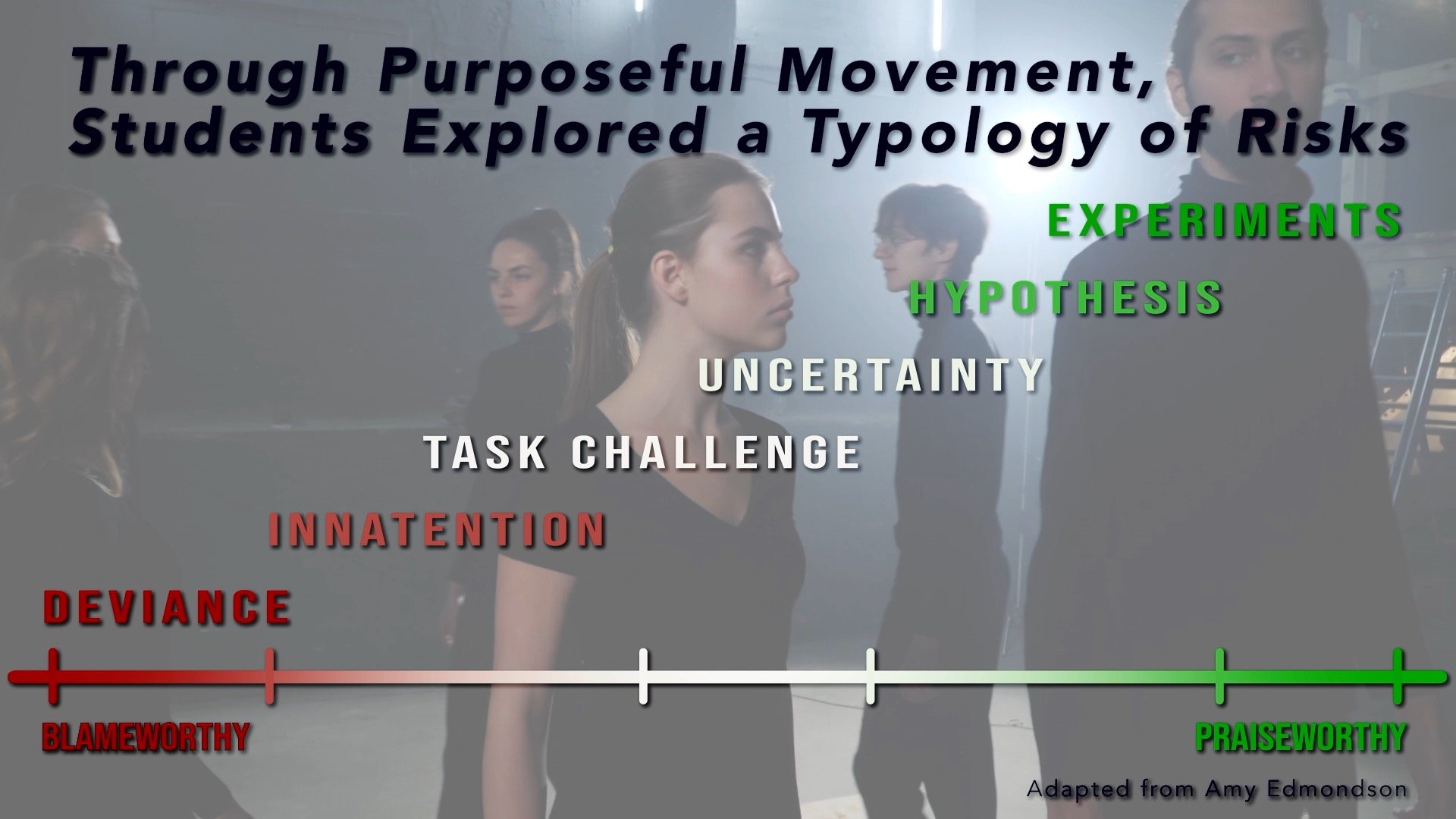
Leading teams through volatility, uncertainty, complexity, and ambiguity requires building psychological safety: a culture of belonging, learning and iteration in which members feel safe to candidly express diverse ideas, concerns, questions, and admit to mistakes. Essential to such cultures is clearly differentiating between types of risks and reasons for undesirable outcomes.
This experiential workshop begins by drawing on artistic processes, together with purposeful movement and group improvisation, to enable participants to clearly identify risks on a continuum: From those that test ideas, expand knowledge and are to be celebrated as agents of innovation even when they lead to unwanted results, to risks that harm collective efforts, often when an individual elevates themselves above the group, such in situations where a person decides not to carry their weight in a collective project.
We then examine the stories we tell ourselves about reasons for failure, with emphasis on probing the conditions underlying what has occurred — even when “blameworthy” — in order to guide team efforts with greater humanity, towards deepened understanding of all members’ needs and experiences.
___________
• Duration (excluding setup): 1.5-2 hrs
• Group Size: Flexible, please contact ASC to discuss your needs
• Team: 1-2 Arts SoCo facilitators + 1 support staff depending on group size

Listening Through The Music
Team-Building Through Musical Improvisation
Exciting, quickly learned movement and music improv games give powerful tools to working with others: the abilities to tune in, connect, and respond spontaneously and meaningfully to one another. These games reset ordinary power dynamics, setting up cooperative models where every voice matters.
Geared for facilitators, general classroom teachers and music educators, this experiential workshop builds team work and leadership through games in music and movement improvisation.
Initially created for mediation organizations like Seeds of Peace, this workshop has been adapted for classrooms, choirs, theatrical casts and professional work environments.
No previous musical or movement experience required. Participants should come ready to move, play and get curious.
___________
• Duration (excluding setup): 1.5-2 hrs
• Group Size: Flexible, please contact ASC to discuss your needs
• Team: 1 Arts SoCo facilitators + 1 support staff depending on group size